

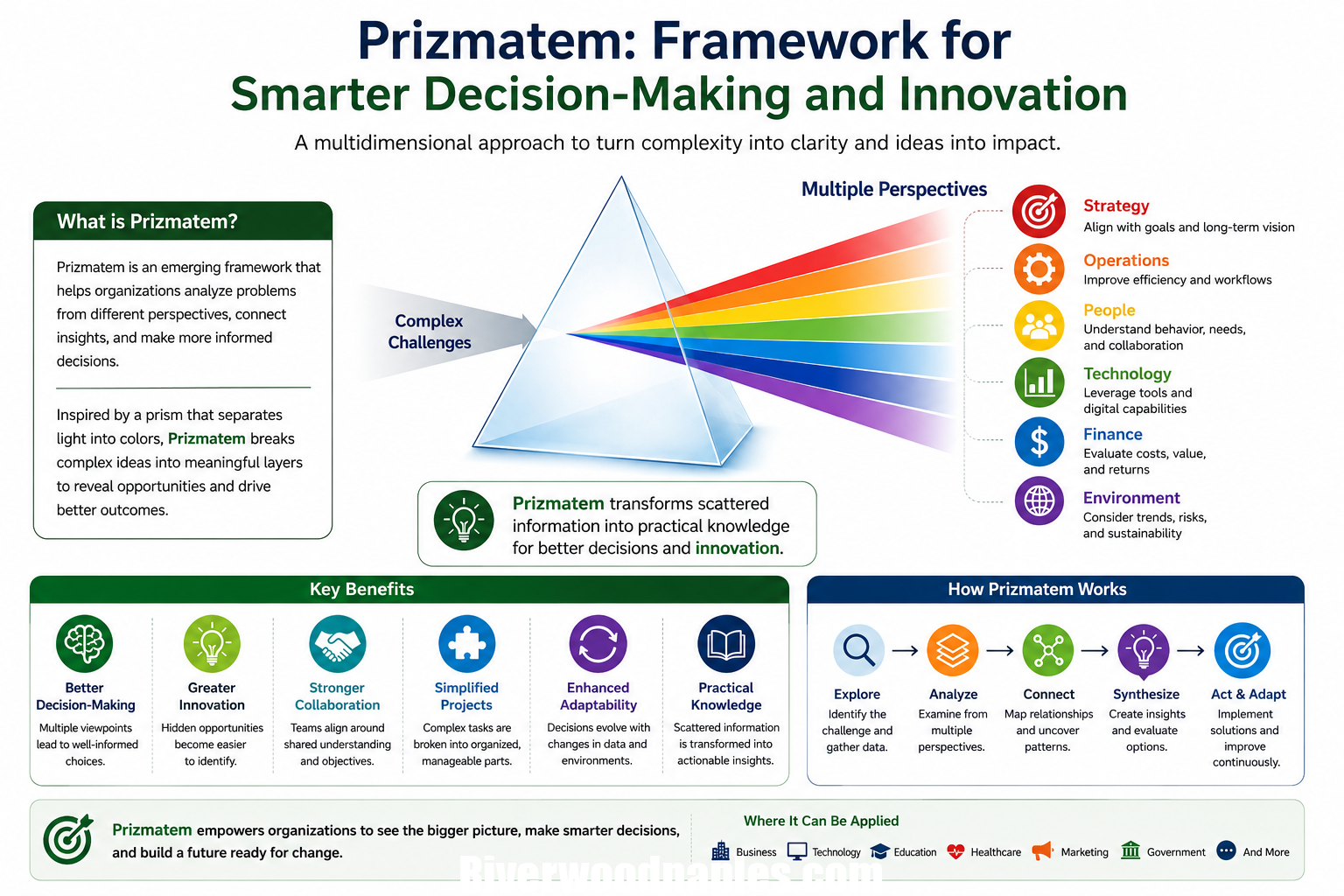
Prizmatem is an emerging concept that is gaining attention as a multidimensional framework for solving complex problems and improving decision-making. Inspired by the way a prism separates white light into different colors, it breaks down complicated information into clear, manageable layers, making it easier to identify patterns, relationships, and opportunities. Rather than relying on a single perspective, it encourages individuals and organizations to evaluate challenges from multiple viewpoints before making informed decisions.
Although it does not yet have a universally accepted definition, it is increasingly discussed in areas such as technology, business strategy, artificial intelligence, education, and digital transformation. Its primary goal is to transform scattered information into meaningful insights, helping teams collaborate more effectively, adapt to change, and develop innovative solutions in today’s fast-paced digital world.
What Is Prizmatem?
It is best understood as a conceptual framework that encourages multidimensional thinking when solving problems or making decisions. Rather than analyzing information from a single perspective, it organizes ideas into multiple connected layers that reveal relationships, patterns, opportunities, and potential risks.
Unlike traditional linear approaches, Prizmatem focuses on viewing challenges through strategic, technical, operational, behavioral, and environmental perspectives simultaneously. This broader approach helps reduce uncertainty and supports more balanced decisions.
Although some online sources describe it as a technology architecture while others present it as a business methodology or digital platform, there is currently no single official definition. Instead, it represents an evolving concept that combines systems thinking, structured analysis, and collaborative problem-solving.
The Origin and Evolution of Prizmatem
The name appears to combine two key ideas:
- Prism – representing clarity, multiple perspectives, and hidden insights.
- System or Methodology – representing organized processes and structured decision-making.
Just as a prism reveals the complete spectrum of light, Prizmatem seeks to reveal every important dimension of a challenge before decisions are made.
The concept has become increasingly visible through discussions surrounding digital transformation, innovation management, artificial intelligence, and business strategy. While it has not yet become an officially standardized methodology, its growing popularity reflects the increasing need for frameworks that simplify complexity and improve collaboration.
Is Prizmatem an Official Framework?
One of the most common questions surrounding it is whether it is an officially recognized framework.
At present, no internationally recognized standards organization or academic institution has published an official definition of it. Different websites describe it in different ways, with some presenting it as a technological architecture and others focusing on its role in strategic planning or digital collaboration.
Because of these varying interpretations, it is most accurate to view Prizmatem as an emerging conceptual framework rather than a universally accepted industry standard.
Its flexibility allows organizations to adapt its principles to their own workflows, making it useful across many disciplines without being restricted to a single implementation.
How It Works
The central purpose of it is to transform complex information into structured knowledge.
Instead of treating every problem as a single issue, the framework encourages breaking it into several interconnected dimensions. Each dimension contributes unique insights before a final decision is reached.
For example, when evaluating a new business initiative, it may consider:
- Business objectives
- Customer expectations
- Technical feasibility
- Financial impact
- Operational resources
- Market conditions
- Long-term sustainability
By examining each perspective separately and then combining the results, organizations can make more informed decisions while minimizing hidden risks.
The Three Core Domains of Prizmatem
Technology and Data Processing
Within technology, Prizmatem is often described as a layered framework for managing information more efficiently.
Some interpretations divide its architecture into conceptual components such as:
- Photon Integration Layer (PIL) – organizes raw information into structured visual patterns.
- Semantic Core Engine (SCE) – analyzes relationships, context, and user intent using intelligent processing techniques.
- Modular Execution Channels (MEC) – divide large processes into smaller independent tasks that improve flexibility and performance.
Although these components are conceptual rather than standardized technologies, they illustrate how layered analysis can improve information management.
Business Strategy of Prizmatem
Business leaders frequently face decisions involving uncertainty, competition, and changing customer expectations.
It encourages organizations to follow a structured workflow that includes:
- Decomposition
- Refraction
- Correlation Mapping
- Synthesis
- Adaptation
This process allows teams to identify risks, compare alternatives, connect related information, and continuously refine strategies as market conditions change.
Digital Platforms and Knowledge Management
Another interpretation of Prizmatem focuses on organizing digital information.
Content creators, educators, researchers, and marketing teams often manage information across multiple platforms. It encourages connecting those resources into a unified knowledge system that improves collaboration and reduces duplicated effort.
Instead of isolated documents, projects become connected ecosystems of information.
Core Principles of Prizmatem
Several principles define how the framework operates.
Multidimensional Thinking
Every challenge should be viewed from several perspectives before reaching conclusions.
Structured Analysis
Large problems become easier to understand when divided into smaller components.
Collaboration of Prizmatem
Effective solutions often require expertise from different departments and disciplines.
Adaptability
Strategies should evolve as new information becomes available.
Evidence-Based Decisions
Reliable information should guide every recommendation rather than assumptions or personal bias.
Continuous Improvement
Every project should contribute lessons that strengthen future decisions.
Applying Prizmatem Step by Step
Organizations can implement it through a practical workflow.
Clearly define the problem or objective.
Gather relevant information from reliable sources.
Separate the issue into strategic, technical, operational, and user-focused perspectives.
Identify patterns, relationships, and potential risks.
Compare possible solutions using measurable criteria.
Select the most balanced approach.
Monitor results and refine decisions based on new evidence.
This structured process allows teams to remain flexible while maintaining clear direction throughout the project.
Practical Applications of Prizmatem
One of its greatest strengths is its versatility.
Artificial Intelligence
AI systems generate enormous amounts of information. Prizmatem helps organize that information into meaningful insights that support human decision-making.
Business Intelligence
Companies can combine financial reports, customer analytics, operational metrics, and market research to develop more effective business strategies.
Product Development
Development teams can evaluate customer needs, technical requirements, production costs, and usability before launching new products.
Prizmatem in Healthcare
Medical professionals can analyze patient information, treatment options, operational efficiency, and healthcare policies together to improve patient outcomes.
Education
Teachers can encourage students to examine topics from multiple perspectives, promoting critical thinking instead of simple memorization.
Digital Marketing
Marketing teams can combine audience behavior, campaign performance, customer feedback, and market trends to optimize future strategies.
Benefits of Using Prizmatem
| Benefit | How Prizmatem Helps |
| Improved Decision-Making | Encourages evaluating multiple perspectives before making decisions, leading to more balanced and informed outcomes. |
| Greater Innovation | Reveals hidden opportunities and encourages creative thinking by examining problems from different angles. |
| Stronger Collaboration | Creates a shared understanding of goals and priorities, enabling departments and teams to work more effectively together. |
| Simplified Project Management | Breaks complex projects into structured, manageable components, making planning and execution more organized. |
| Enhanced Adaptability | Allows strategies and decisions to evolve as new information, market conditions, or business requirements change. |
| Better Knowledge Organization | Transforms scattered information into structured insights, helping organizations manage data and knowledge more efficiently. |
Challenges and Limitations
Despite its advantages, Prizmatem is not without challenges.
Because it is still an emerging concept, different interpretations may create confusion.
Organizations may require additional training to ensure consistent implementation.
The quality of decisions depends heavily on reliable data.
Analyzing multiple perspectives can also increase complexity if priorities are not clearly defined.
Finally, successful implementation requires both technological support and strong collaboration among stakeholders.
Best Practices for Successful Implementation
To maximize the value of Prizmatem, organizations should:
- Define clear objectives before beginning analysis.
- Encourage collaboration across departments.
- Collect reliable and relevant data.
- Document assumptions and decisions.
- Measure outcomes using meaningful performance indicators.
- Continuously review and improve the framework.
Small improvements over time often produce greater long-term results than attempting large transformations all at once.
Common Misconceptions About Prizmatem
Several misconceptions have developed around the concept.
It is not currently recognized as an international standard.
Not a standalone software application.
It is not an artificial intelligence model, although it may complement AI-powered systems.
Instead, it should be viewed as a flexible framework that supports structured thinking and informed decision-making.
The Future of Prizmatem
As businesses continue adopting artificial intelligence, automation, and advanced analytics, frameworks capable of organizing complex information will become increasingly valuable.
Future developments may integrate Prizmatem principles with predictive analytics, knowledge management platforms, collaborative digital workspaces, and intelligent decision-support systems.
Rather than replacing human expertise, these technologies are likely to enhance it by providing clearer insights and more structured ways to evaluate complex situations.
Whether or not it evolves into a formal methodology, its emphasis on multidimensional analysis reflects an important shift toward smarter, evidence-based decision-making.
Conclusion
Prizmatem represents an emerging way of thinking that encourages individuals and organizations to approach challenges from multiple perspectives rather than relying on simple, linear solutions. Inspired by the concept of a prism, it emphasizes clarity, structured analysis, adaptability, and collaboration.
Although there is currently no universally accepted definition or official standard, its growing popularity highlights the increasing demand for frameworks that help simplify complexity in an increasingly data-driven world.
Whether applied to technology, business strategy, healthcare, education, or digital transformation, it offers a practical mindset for connecting information, improving collaboration, and making more informed decisions. As organizations continue navigating complex digital environments, the principles associated with Prizmatem may become increasingly relevant for shaping smarter and more adaptable strategies.