

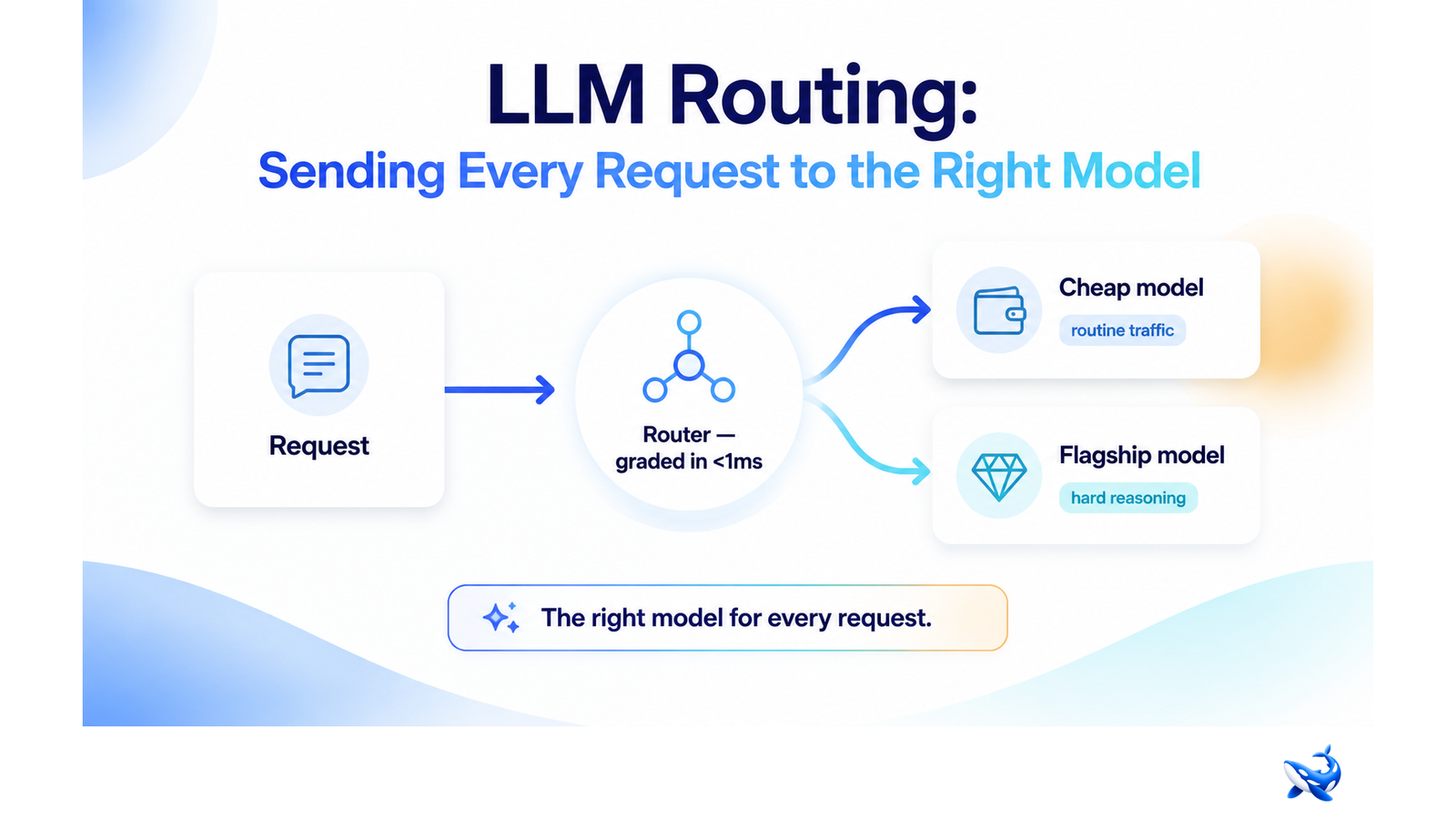
llm router is the practice of choosing which model answers each request — a decision layer between your application and every model provider that sends routine traffic to a cheap model and escalates hard reasoning to a flagship. In practice the decision runs across models like GLM-5.3, not a hand-picked shortlist; this piece is the plain-English version of why routing emerged, how the decision gets made, and what it changes in practice.
The reason it exists is a fork in every request. The model market now spans 200-plus models across OpenAI, Anthropic, Google, Meta, Mistral, xAI, DeepSeek and more [OURS], from frontier flagships that think for seconds to small models that stream a reply in milliseconds. Costs and behaviors diverge wildly across that range: a question that costs a few tenths of a cent at the budget end can cost an order of magnitude more from a flagship. Left to its own devices, your code has to pick one lane and stay in it — paying flagship prices for questions a cheap model could answer, or sending genuinely hard problems to a model that isn’t up to them.
What LLM routing actually is
LLM routing is a classification decision applied to every request: which model should answer this one? It sits between your business logic and the model call — a request comes in, it gets matched to a model, and the response comes back. Everything else is implementation detail.
Routing is worth distinguishing from two neighbors it gets confused with. Load balancing spreads identical traffic across identical replicas to keep latency flat under load. Routing sends different traffic to different models because they are different. And a fallback — catching a failure and retrying — is one half of routing, not the whole thing: routing is the decision about where the request goes in the first place, not just what happens when that choice fails.
Where does the decision live? Three answers, in practice. Hardcoded in your application: a switch statement that pins each feature to a model and gets edited by hand every time the market moves. Configured centrally in a routing layer: a service that owns the model catalog and the policy, so your app just asks for an answer. Or handed to an external router: a gateway that stands between your app and every provider and makes the call per request. The first works for one workload; the second and third are what scale.
Why routing emerged
Routing became a practice because three gaps opened up in the model market around the same time.
Model proliferation. One API key can now reach 200-plus models [OURS], and each release cycle adds more. A few years ago a team could pick one model and stop thinking about it; today that choice is a moving target — last month’s best model is this month’s mid-tier option, and new providers keep entering the race.
Cost spread. List prices differ by an order of magnitude or more between a frontier flagship and the cheapest model that can hold a normal conversation. Send everything to the flagship and your invoice scales with your traffic. Route the routine 80 percent to a budget tier and the expensive model only shows up when it’s actually worth it.
Latency differences. Flagships often reason for seconds before their first token; cheap models stream immediately. For a user waiting on a chat reply, a five-second thinking pause changes the product. Same request, different acceptable price, different acceptable wait — the routing decision has to weigh both.
Reliability differences. Models go down, get rate-limited, change quality between versions, and occasionally return garbage. A routing layer turns “hope the one model stays up” into a chain of fallbacks, so a single provider hiccup stops being a production incident.
How the routing decision gets made
Once you decide to route, the interesting question is how. A working router has to judge each request and then apply policy. In practice the decision combines four inputs.
Prompt grading. Score the request before routing it. Does it need math, code, multi-step reasoning — or is it a lookup? OrcaRouter’s adaptive routing grades each prompt in under 1ms before choosing the cheapest model that meets your standard [OURS]. Grading is the core of the whole practice; without it, routing is just guessing.
Cost floors. Set a ceiling on what a request may spend. If the prompt is simple, route it to the budget tier even though a flagship would also answer — you’re not shopping for the best answer, you’re shopping for the best answer within a budget.
Latency budgets. If a user is waiting inline, route to the fast model. If the request is a background job with nobody watching, allow the slow flagship. Same task, two routes, because the wait matters in one case and not the other.
Fallback chains. Every route needs an escape hatch: if the primary model fails, times out, or hits a rate limit, the request moves to the next model on the chain. Automatic failover is what turns a provider outage from a pager alert into a blip [OURS].
| Hardcoded in the app | Router-managed | |
| A new model ships | Edit code, redeploy | One config change |
| Requests graded | Never — one model for everything | Yes, per request |
| Failure handling | Manual retry, or nothing | Automatic failover chain |
| Cost control | Fixed by the model you chose | Cost floors and budgets |
| Observability | Logging you build and maintain | Request logs per call |
The measurable wins
Routing isn’t a philosophy — it pays for itself in four measurable ways.
Cheaper blended cost. This is the headline. Route the routine volume — the support FAQ, the summarization. The classification — to a cheap model at the $0.20 tier, and escalate only hard reasoning to the flagship. Your blended cost per request collapses while the answer quality users actually see barely moves, because the hard requests still hit the flagship. The budget model handles the volume; the flagship handles the cases where a wrong answer is expensive.
Fewer failures. Fallback chains mean a rate limit or outage at one provider no longer fails the request — the next model in the chain answers it. Reliability stops being a single point of failure.
One integration. Instead of maintaining three SDKs, three contracts and three billing systems, you integrate once. One API key reaches 200-plus models [OURS], and switching or adding a model is a config change rather than a deployment.
Observability for free. With a routing layer, every request is logged — which model answered, at what cost, how fast. The budget becomes a report instead of a spreadsheet.
When routing helps — and when it doesn’t
Route when your traffic spans more than one kind of task, when the model bill is big enough to notice, or when downtime is expensive. That combination covers most production workloads: an app with a chat surface, a summarization pipeline and a few high-stakes agentic flows is a textbook routing candidate.
Skip it when you have one workload, one model, one provider, and the invoice is already fine. Routing adds a decision where there is nothing to decide. And skip it if you’re not prepared to measure: routing only pays off when you know which requests were expensive and which model answered them.
If you’re unsure whether your traffic justifies it, the experiment is cheap. A router that passes provider list prices through at 0% markup [OURS] lets you put routine volume on a budget tier and keep the flagship for the hard cases — no second contract, no code rewrite, just a policy.
The takeaway
LLM routing is the practice of sending every request to the model best suited to it: cheap models absorb the routine volume, flagships handle the hard reasoning, fallback chains absorb the failures, and one integration replaces a pile of SDKs. It emerged because the model market exploded in breadth, price, latency and reliability — and it pays for itself in blended cost, uptime and engineering time. Start simple, grade every prompt, set a cost floor, and measure what actually gets routed. The models will keep changing; the routing layer is what keeps your system stable while they do.
Sourcing note: OrcaRouter’s product facts — 200+ models behind one API key, prompt grading in under 1ms, 0% markup (provider list prices passed through with no added margin) and automatic failover — come from OrcaRouter’s official homepage and product pages, checked August 22, 2026. The $0.20 per million input tokens tier is used as an illustrative example of the budget end of the market. Cost, latency and reliability differences between model tiers are described qualitatively; no specific vendor prices were cited.