

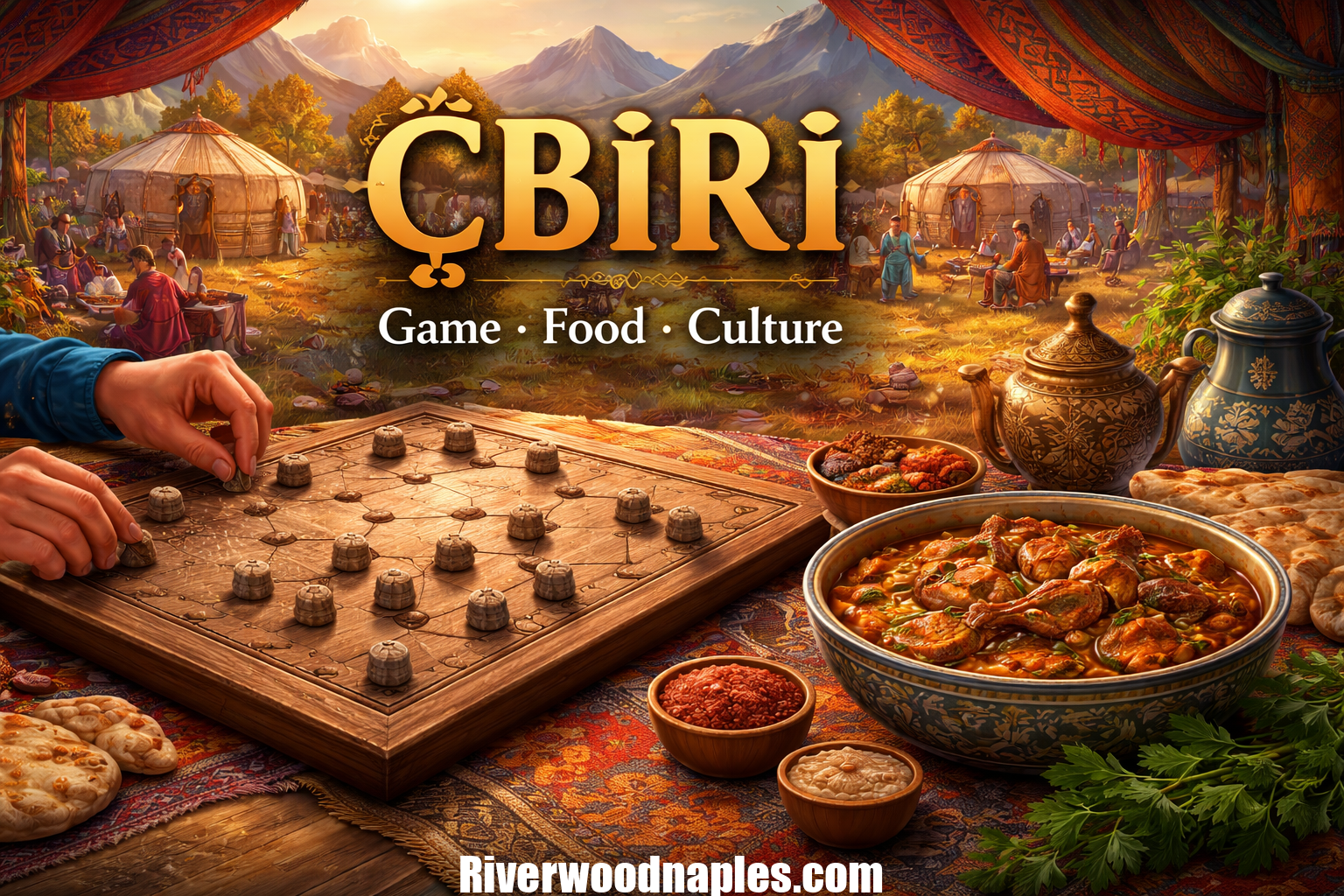
Some words carry entire worlds within them. Çbiri is one such word. To call it simply a board game would be like calling the Silk Road a footpath. To say it is only a dish would reduce centuries of tradition to a mere recipe. It is, at its core, a multi-dimensional cultural phenomenon — a single word that breathes strategy, flavor, symbolism, and community all at once.
Originating among the nomadic Turkic tribes of Central Asia, it has traveled through centuries and across continents. Today it lives in Turkish homes, Central Asian festivals, Balkan traditions, and even African communal gatherings. It is a testament to the extraordinary power of shared human experience — proof that some traditions are too alive to die.
Understanding it means accepting that culture rarely fits neatly into a single box. Its richness lies precisely in its layers, and each layer, once uncovered, reveals something profound about the people who have carried it forward across generations.
Origins and History of Çbiri
The Nomadic Roots
The story of it begins on the vast steppes of Central Asia, among Turkic nomadic tribes who moved across open landscapes, living in tents, riding horses, and surviving through collective wisdom. These communities did not have libraries or academies, but they had something equally powerful: oral tradition, strategic thinking, and a deep reverence for community bonds.
Çbiri emerged in this environment as a practical tool. It was a way to teach the young — not in classrooms, but around fires and under open skies. The game aspect of it trained minds in foresight, patience, and tactical decision-making. These were not abstract virtues. On the steppe, they were survival skills.
Migration and Evolution
As Turkic communities migrated westward over centuries, eventually settling in Anatolia and forming what would become modern Turkey, they carried Çbiri with them. Like all living traditions, it adapted along the way. New regions added their own flavors — literally and figuratively. The game absorbed new rules. The food took on local spices. The symbolism blended with new spiritual and artistic influences from every culture it touched.
What began as a practical tradition among nomads transformed, over hundreds of years, into a rich and layered cultural institution. Each region that embraced it gave it something new while preserving its essential spirit — making it both universal and deeply local at the same time.
Archaeological and Historical Evidence
While precise archaeological records specific to Çbiri remain limited — as is often the case with oral traditions — artifacts consistent with the game’s description have been found across ancient sites in Central Asia and Anatolia. These findings, combined with accounts preserved in folklore and oral literature, suggest that it roots stretch back many hundreds of years, long predating written records of the tradition itself.
“Çbiri traces its roots to the nomadic Turkic tribes of Central Asia, where strategic thinking was vital for survival. Originally more than a game, it functioned as a tool for teaching young tribespeople critical skills such as foresight, patience, and tactical planning.”
Çbiri as a Strategic Board Game
How the Game Is Played
At its most concrete level, it is a two-player strategy board game played on a square board. Often compared to a combination of chess and checkers, the objective is to capture all of an opponent’s pieces or block their movements entirely. The game is deceptively simple to learn but deeply challenging to master — a quality that has sustained fascination with it across generations.
The game is traditionally played with simple, handcrafted pieces — stones, carved wood, or seeds — reinforcing its roots in accessible, communal play rather than elite entertainment. Anyone, regardless of background or wealth, could sit down and participate.
Skills the Game Develops
Çbiri is far more than recreation. Educators and cultural scholars have noted its remarkable capacity to develop a wide range of cognitive and social skills:
- Strategic planning — players must think several moves ahead, constantly anticipating an opponent’s response
- Critical thinking — every decision carries consequence, demanding careful evaluation before action
- Patience and emotional control — rushing leads to mistakes; the game consistently rewards composure
- Problem-solving — adapting to unexpected moves requires flexible, creative thinking in the moment
- Social intelligence — reading an opponent, managing competitive tension, and engaging gracefully in both victory and defeat
The Social Life of the Game
What separates Çbiri from a simple board game is the rich social architecture that surrounds it. Traditionally, it is never played in isolation. It is embedded in gathering — in shared meals, storytelling, music, and intergenerational conversation. A match of it is as much about the experience around the board as it is about the moves on it.
Elders use the game to pass down wisdom to younger generations. Young people use it to demonstrate readiness and growing maturity. Families gather around it during festivals and celebrations. Communities host it evenings that blend competition with joy. In this sense, the game functions as a social technology — a finely tuned instrument for building and maintaining thethat hold communities together.
Çbiri as a Traditional Food
The Dish Itself
Parallel to the game, it also refers to a traditional slow-cooked dish — typically featuring spiced lamb or beef, served with rice or bread depending on the region. The preparation is unhurried by design. Slow cooking here is not merely a technique; it is a philosophy. It reflects the same values embedded in the game: patience, care, and a deep respect for process over speed.
The dish varies by region. In some areas it is rich with aromatic spices and fragrant herbs. In others it is simpler and more austere, allowing the quality of the ingredients and the time invested to speak for themselves. What remains constant across all regional variations is the context in which Çbiri food is served — communally, and with deep intention.
Food as Cultural Expression
The dish is not simply sustenance — it is a statement. Preparing and sharing it signals hospitality, respect, and belonging. When a family prepares for guests, they communicate something no words can fully capture: that you matter enough for us to invest time, care, and tradition in your welcome.
This connection between the food and the game is not coincidental. Require patience. Both are best experienced in company. Both carry layers of meaning far beyond their surface function. The single word encompassing both is a linguistic expression of a deeper cultural truth — in this tradition, strategy and nourishment have always been inseparable.
Çbiri as a Cultural Symbol
Symbolism and Meaning
Beyond the game and the dish, it carries a powerful symbolic dimension. The intricate patterns associated with it art and craft represent unity and interconnectedness — the idea that individuals are strongest when woven together into community. Colors used in traditional Çbiri designs each carry specific meanings:
| Color | Symbolic Meaning |
| Deep red | Strength and resilience |
| Gold and amber | Hope and prosperity |
| Earth tones | Ancestral roots and belonging |
| White | Purity and new beginnings |
| Dark blue | Wisdom and depth of tradition |
Displaying or wearing its motifs has long been understood as a sign of respect for one’s ancestry. It is not merely decorative — it is a declaration of identity, a quiet but powerful affirmation of where one comes from and what one values.
Çbiri as a Rite of Passage
In many Central Asian communities, it holds a particularly significant role as a rite of passage. It marks the transition from childhood to adulthood. A young person’s ability to play well — to demonstrate patience, strategy, and composure — signals a readiness for the responsibilities of adult community life. The game becomes a mirror of character, and mastering it becomes a moment of genuine cultural significance.
This dimension elevates it far above entertainment. It becomes a threshold — a moment in which tradition, identity, and personal growth all converge.
Çbiri Across Regions and Cultures
One of the most remarkable qualities of it is its geographic reach. Few traditions travel as far and adapt as gracefully. Across six distinct regions, Çbiri has found a home — each time taking on local color while preserving its essential spirit.
Regional Significance at a Glance
| Region | Significance |
| Central Asia | Birthplace of the tradition; tied to nomadic survival and community wisdom |
| Turkey / Anatolia | Central to social festivals, family gatherings, and cultural identity |
| The Balkans | Connected to Albanian linguistic roots; blends with local folk traditions |
| Middle East | Symbol of resilience; woven into folklore, art, and oral literature |
| South Asia | Carries spiritual significance; believed to bring protection and prosperity |
| Africa | Represents unity; used in communal celebrations and as a bridge between peoples |
Why Çbiri Travels So Well
The reason it has taken root in such diverse cultural soils is not accidental. Its core values — patience, community, strategy, and shared nourishment — are not specific to any one people. They are human universals. Every culture that has encountered Çbiri has recognized something familiar in it, something that resonates with its own deepest traditions. That recognition is the secret of its endurance.
Çbiri in Community and Social Life
Gatherings and Festivals
It has always thrived in the context of community celebration. Across the regions where it is practiced, communities organize dedicated Çbiri gatherings — evenings and festival days built around the game, the food, music, and storytelling. These are not passive events. They are living expressions of cultural identity, moments where tradition is not merely remembered but actively practiced and renewed.
The following elements are typically present at a traditional gathering:
- The game, played in rounds with rotating participants
- The slow-cooked dish, prepared communally and shared
- Traditional music appropriate to the regional context
- Storytelling by elders, often weaving the history of itself into the evening
- Moments of teaching, where experienced players guide younger participants
Intergenerational Bonding of Çbiri
Perhaps the most quietly powerful function of it is the bridge it builds between generations. In a world increasingly defined by digital separation and generational disconnection, it offers something rare: a shared activity that genuinely requires both the wisdom of the old and the energy of the young.
Grandparents teach grandchildren not just the rules of the game, but the philosophy behind it. Patience. Respect for the opponent. Grace in defeat. Joy in mastery. These are lessons that no algorithm can deliver — they require a human being sitting across from another human being, fully present, fully engaged.
Wellness and Mental Health Benefits
Modern research increasingly validates what traditional communities have always known intuitively. Participation in shared cultural practices like Çbiri delivers measurable benefits:
- Reduced social isolation through regular community engagement
- Cognitive stimulation through strategic gameplay that challenges and develops the mind
- Emotional regulation through the discipline and patience the game demands
- Sense of belonging through participation in a tradition larger than any individual
- Intergenerational connection that enriches both older and younger participants
Çbiri in the Modern World
Contemporary Adaptations
It is not frozen in the past. Like all living traditions, it has moved with the times. Contemporary artists and designers are reinterpreting Çbiri motifs in modern visual art, fashion, and interior design. Writers are weaving it themes into literature and poetry. Digital versions of the game have begun to appear, introducing the tradition to global audiences who may never have encountered it otherwise.
These adaptations reflect a healthy cultural vitality. Tradition does not survive by standing still — it survives by remaining relevant, by finding new expressions without losing its essential meaning.
Social Media and Global Reach
Social media platforms have played a significant role in spreading awareness of it beyond its traditional geographic boundaries. Enthusiasts share game strategies, traditional recipes, and cultural insights with global audiences. Online communities of it players have formed, connecting people across continents who share a passion for the tradition.
This digital expansion is largely positive — it introduces it to new generations and new cultures. However, it also brings challenges that must be navigated thoughtfully.
Controversies and Challenges of Çbiri
The growing popularity of it is not without tension. Three key challenges face the tradition in the modern era:
- Authenticity versus evolution — As it adapts to modern contexts, ongoing debate exists about how much change is healthy and how much risks erasing the tradition’s essential meaning
- Commercialization — The growing trendiness of it motifs and aesthetics has attracted commercial interest that does not always come with cultural understanding or respect
- Cultural appropriation — The line between genuine appreciation of Çbiri and exploitation of its imagery without understanding its significance is a subject of increasing discussion among cultural custodians
These are not simple questions. They require ongoing, honest conversation between those who carry the tradition and those who encounter it from the outside.
How to Experience Çbiri Today
Playing the Game
For those who wish to engage with it as a game, the entry point is accessible. The following steps offer a practical path:
- Seek out cultural organizations, Turkish cultural centers, or Central Asian community groups in your area who may host Çbiri events
- Begin with the basic rules — the game is learnable in a single session, even if mastery takes far longer
- Play with patience and a spirit of curiosity rather than pure competition
- Ask experienced players about the tradition behind the game — the stories are as valuable as the strategy
Cooking the Dish
Preparing it food is an act of cultural participation in itself. The slow-cooked dish rewards patience and attention:
- Source quality lamb or beef and do not rush the cooking process
- Research regional variations to discover which interpretation resonates with you
- Cook it communally when possible — invite family or friends into the kitchen
- Serve it as it was always meant to be served: generously, and in good company
Incorporating Çbiri into Daily Life
Beyond the game and the dish, it can be woven into daily life in meaningful ways:
- Home decor — art pieces, textiles, and ceramics featuring motifs bring the tradition into living spaces
- Fashion — accessories incorporating traditional patterns are both beautiful and culturally expressive
- Community engagement — attending or organizing Çbiri-themed cultural evenings strengthens local community bonds
- Education — introducing children to it as both a game and a cultural story plants seeds of cross-cultural understanding
Why Çbiri Still Matters
In an age of digital distraction, algorithmic entertainment, and deepening social fragmentation, it offers something that no app or platform can replicate. It offers presence — two people, fully attentive to each other and to the game between them. Offers nourishment — not just of the body, but of the social and spiritual dimensions of human life. It offers continuity — a living thread connecting the present to a past that stretches back across centuries.
The communities that have carried Çbiri forward through generations understood something that modern society is only beginning to rediscover: that the quality of a life is measured not by the speed of its distractions but by the depth of its connections. Every game of it played, every pot of the slow-cooked dish shared, every motif woven into fabric or painted onto wood is an act of resistance against forgetting — a quiet, determined insistence that some things are worth preserving.
Conclusion
It is not a relic. It is not a museum piece or a nostalgic curiosity. Living tradition — breathing, adapting, traveling, and continuing to find new people who recognize in it something true and valuable. Board game that teaches wisdom. It is a dish that expresses love. It is a symbol that declares identity. And it is a community practice that weaves individuals into something larger than themselves.
To engage with Çbiri — whether at the board, at the table, or through its art and symbolism — is to participate in one of humanity’s oldest and most enduring conversations: the conversation about how we live well together.
In every move on the board, every bite of the dish, and every pattern woven into its art, it whispers the story of humanity’s deepest need — to connect, to endure, and to pass something worthy on to those who come after us.